Choosing a High Power DC Motor in 2026 is not simply a matter of selecting the largest wattage. The correct choice begins with the machine’s real workload, operating environment, and expected service life. A conveyor may need steady torque at low speed, while a mobile platform may demand rapid acceleration and frequent braking.
Professor David G. Dorrell, a recognized motor-design researcher, offers a practical principle: “Motor selection must begin with the load, not the catalogue.” That advice remains valuable. Engineers should examine continuous torque, peak torque, voltage limits, duty cycle, thermal rise, and controller compatibility. A motor rated at 10 kW may fail early if ventilation is poor or repeated overloads exceed its cooling capacity.
Measure the load carefully.
Include starting conditions.
Look beyond peak power.
In field applications, small details matter. Dust can block cooling paths. Long cables can increase voltage drop. A heavy shaft coupling can change acceleration time. Brushed designs may simplify control, but brush wear can increase maintenance. Brushless alternatives may offer longer service life, although they require suitable electronic commutation.
Reliable selection also requires evidence. Compare manufacturer curves, efficiency maps, insulation ratings, protection levels, and tested operating limits. Do not rely on marketing language alone. I have seen specifications that looked impressive but ignored continuous-duty performance. That is where judgment becomes important.
This guide explains how to compare a High Power DC Motor by application, torque demand, thermal behavior, control method, and lifecycle cost. Some decisions will remain imperfect. The goal is not the biggest motor, but the safest and most dependable match.
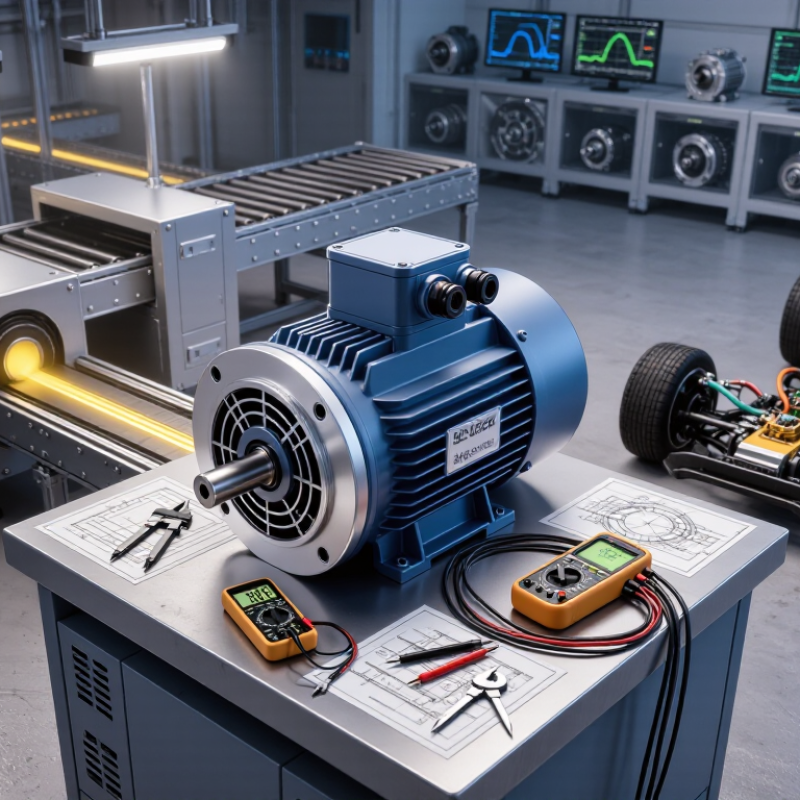
In 2026, a high-power DC motor is not defined by wattage alone. It must deliver substantial torque at the required speed, often under continuous or repeated load.
Real selection starts with the machine’s duty cycle. A motor producing 5 kW for ten seconds differs greatly from one producing 5 kW for eight hours.
Heat matters. Engineers should examine copper loss, cooling airflow, ambient temperature, and allowable winding temperature.
From field testing, I would treat rated power as only one checkpoint. Check continuous torque, peak torque, stall limits, efficiency, and speed range. Then compare the motor with the controller, battery, gearbox, and mechanical load.
A mismatch can cause overheating, unstable acceleration, or early bearing wear. An encoder can improve speed control, especially when the load changes quickly. The datasheet should clearly report test conditions, not just impressive peak figures.
A reliable high-power motor also needs thermal sensors, current limiting, suitable insulation, and accessible service points. Sealed housings may protect against dust, yet they can trap heat. That tradeoff is easy to miss.
I have seen calculations fail because startup torque was ignored. Recheck the worst case, including cold starts, sudden loads, and voltage drops.
Measure actual temperatures during testing. Paper estimates are useful, but imperfect.
Choosing a high-power DC motor in 2026 requires more than comparing wattage. The correct match begins with your application’s real operating conditions. Record the required speed, continuous torque, peak torque, duty cycle, supply voltage, and available installation space. A conveyor may need steady torque for hours, while a robotic actuator may demand short, powerful movements. These applications require different motor and controller choices.
Check the load at startup, during normal operation, and during sudden changes. Calculate torque from the load, pulley radius, and acceleration. Then include a practical safety margin, usually without over-sizing excessively. An oversized motor can increase cost, weight, and energy use. Thermal limits also matter. In a sealed machine near a hot furnace, a motor rated for room temperature may fail early. Measure the actual housing temperature during testing.
Tips: Match the motor’s continuous rating to continuous demand. Match peak ratings to brief acceleration events. Confirm encoder feedback, braking needs, controller compatibility, and protection against dust or moisture. Test under real load, not only on a workbench.
A spreadsheet can look correct, yet field conditions often expose missing details. Cable voltage drop, misaligned shafts, and frequent reversals can change performance. I have seen calculations pass comfortably, then fail after adding friction and poor ventilation. Leave room for those uncertainties. Review the selection with a qualified engineer and document every assumption before production.
Choosing a high-power DC motor in 2026 starts with the machine’s real workload, not its advertised peak output. A brushed motor can suit simple systems with limited operating hours and easier maintenance access. A brushless DC motor usually offers longer service life, lower electrical noise, and better efficiency. For pumps, conveyors, and mobile equipment, continuous torque matters more than a short power surge. Measure starting load, running load, shaft speed, and duty cycle before selecting a rating.
Do not match the motor wattage too closely to the calculated load. A practical design often leaves 20 to 30 percent thermal capacity. Check the motor’s torque curve at low speed, where cooling may weaken and current can rise sharply. A motor rated for 10 kW may still overheat during repeated starts. That detail is easy to miss. I have seen test plans focus on peak speed while ignoring five-minute acceleration cycles.
The control system should fit the motor type and feedback requirements. Basic voltage control may work for small brushed applications, but high-power systems need current limiting and controlled acceleration. Brushless motors generally require an electronic controller, with Hall sensors or an encoder when precise speed and position matter. Regenerative braking also needs a safe energy path, such as a braking resistor or suitable battery system. Sensorless control can reduce wiring, yet it may perform poorly at very low speed. That trade-off deserves bench testing. A quiet motor is not automatically a reliable one. Check cable temperature, bearing vibration, controller faults, and emergency stopping behavior under realistic loads.
| Motor Type | Typical Continuous Power Range | Typical Speed Range | Typical Efficiency | Key Advantages | Main Limitations | Best-Fit Applications | Recommended Control System |
|---|---|---|---|---|---|---|---|
| 1. Compare the Main Motor Technologies | |||||||
| Brushed DC Motor | 1–500 kW | 300–6,000 rpm | 75–92% | Simple speed control, high starting torque, straightforward four-quadrant operation, and easy torque reversal. | Brush and commutator wear, electrical arcing, maintenance requirements, and reduced suitability for dusty or explosive environments. | Existing DC-bus machinery, cranes, conveyors, rolling equipment, test benches, and applications requiring frequent torque reversal. | Four-quadrant thyristor drive or PWM chopper drive with current, speed, and regenerative control. |
| Brushless DC Motor (BLDC) | 0.2–100 kW | 500–10,000 rpm | 85–94% | No brush wear, compact construction, high power density, and good dynamic response. | Requires electronic commutation, rotor-position feedback or sensorless estimation, and careful electromagnetic compatibility design. | Electric pumps, fans, compressors, traction auxiliaries, robotics, and compact high-speed equipment. | Six-step or sinusoidal inverter using Hall sensors, encoders, resolvers, or sensorless back-EMF estimation. |
| Permanent-Magnet Synchronous Motor (PMSM) | 5–1,000 kW | 500–6,000 rpm | 90–97% | Very high efficiency, high torque density, low rotor losses, and excellent low-speed torque control. | Higher control complexity, permanent-magnet cost, risk of demagnetization under excessive temperature or fault current, and limited field-weakening range compared with some other designs. | Electric traction, high-efficiency pumps, compressors, industrial servo systems, and battery-powered machinery. | Field-oriented control (FOC) or direct torque control with an encoder or resolver; include field-weakening above base speed. |
| Wound-Field Synchronous Motor | 100–10,000+ kW | 300–3,600 rpm | 90–97% | Adjustable power factor, high efficiency at large ratings, and no permanent magnets in the rotor. | Requires a field-excitation system, slip rings or brushless excitation, additional controls, and more complex maintenance. | Large compressors, mills, pumps, generators used as motor drives, and heavy industrial systems. | Voltage-source inverter with separate field-excitation control and closed-loop speed regulation. |
| Induction Motor on a DC Bus | 5–10,000+ kW | 300–3,600 rpm | 88–96% | Rugged rotor, mature supply chain, strong overload capability, and no brushes or permanent magnets. | Rotor copper losses reduce efficiency, low-speed torque requires advanced control, and motor current can be high during acceleration. | Heavy-duty pumps, fans, conveyors, compressors, hoists, and high-power industrial drives. | Voltage-source inverter with scalar V/f control for simple loads or sensorless/sensored FOC for demanding torque control. |
| 2. Select the Power Rating and Electrical Configuration | |||||||
| Design Factor | Typical Engineering Range | Selection Guidance | Practical Check | ||||
| Continuous Mechanical Power | 1–10 kW: light industrial; 10–100 kW: medium duty; 100–1,000+ kW: heavy duty | Select a motor whose continuous rating is at least the calculated steady-state load after considering ambient temperature, altitude, cooling method, and duty cycle. | Avoid sizing only from peak power. Confirm the motor can deliver the required continuous torque at the minimum operating speed. | ||||
| Peak Power and Overload | Common short-term overload capability: 120–200% of rated torque, depending on the motor and drive | Use the actual acceleration, climbing, impact, or load-transient profile rather than applying a generic oversized motor. | Check peak current, inverter current limit, thermal recovery time, shaft stress, and mechanical transmission limits. | ||||
| DC-Link Voltage | 48–120 VDC: low-voltage systems; 200–450 VDC: common industrial and battery systems; 600–1,000+ VDC: high-power platforms | Higher voltage reduces current for the same power, which can reduce conductor size and resistive losses. | For a three-phase inverter, approximate DC input current is: I ≈ P ÷ (VDC × η). Include voltage ripple and minimum battery voltage. | ||||
| Torque Requirement | Torque (N·m) = 9,550 × Power (kW) ÷ Speed (rpm) | Low-speed, high-torque loads may require a larger motor frame, a gearbox, or a field-weakening strategy. | Calculate torque at start, acceleration, rated speed, minimum speed, and every major operating point. | ||||
| Duty Cycle | Continuous duty, intermittent duty, cyclic duty, or short-time duty | A motor with a lower nameplate power can be suitable for intermittent operation if its thermal model supports the real cycle. | Record load duration, idle duration, starts per hour, regenerative periods, and ambient temperature. | ||||
| Cooling Method | Natural convection, forced-air cooling, liquid cooling, or totally enclosed fan cooling | Liquid cooling generally supports higher continuous power density and better thermal control in compact systems. | Verify coolant flow, allowable inlet temperature, filter maintenance, leak protection, and cooling performance at low motor speed. | ||||
| 3. Match the Control System to the Required Performance | |||||||
| Control System | Typical Feedback | Speed Accuracy | Torque Response | Regeneration | Relative Complexity | Best Use Case | 2026 Selection Recommendation |
| Open-Loop PWM / Varying DC Voltage | None or basic current limit | Low | Low to moderate | Usually unavailable | Low | Fans, pumps, simple conveyors, and non-critical speed control | Use only when load variation and speed accuracy requirements are modest. |
| Closed-Loop Speed Control | Encoder, resolver, Hall sensors, or tachometer | Moderate to high | Moderate to high | Possible with a suitable four-quadrant drive | Moderate | Conveyors, winders, machine tools, and applications with changing load | A practical baseline for industrial machines requiring stable speed. |
| Field-Oriented Control (FOC) | Encoder, resolver, Hall sensors, or sensorless estimator | High | High and smooth | Available with a regenerative drive | Moderate to high | Traction, robotics, compressors, high-performance pumps, and high-power battery systems | Preferred for precise torque, efficient operation, wide speed range, and dynamic loads. |
| Direct Torque Control | Usually encoder, resolver, or model-based estimation | High | Very high and fast | Available with a suitable active front end or regenerative stage | High | Hoists, rolling equipment, test systems, and applications with rapid torque changes | Choose when transient torque response is more important than control simplicity. |
| Four-Quadrant Regenerative Control | Current and speed feedback; position feedback when needed | High | High in motoring and braking | Yes | High | Elevators, cranes, downhill conveyors, centrifuges, test rigs, and repeated acceleration/deceleration | Use when braking energy is frequent enough to justify energy recovery and DC-bus management. |
| 4. Final Selection Checklist for a High-Power DC Motor | |||||||
| Load Profile | Confirm continuous torque, peak torque, speed range, acceleration time, braking time, starts per hour, load inertia, and regenerative energy. | ||||||
| Thermal Design | Verify winding temperature rise, insulation class, cooling capacity, ambient temperature, altitude derating, enclosure rating, and bearing temperature limits. | ||||||
| Drive Compatibility | Match motor voltage, rated current, peak current, feedback type, switching frequency, commutation method, braking resistor, and regenerative capability with the controller. | ||||||
| Mechanical Integration | Check shaft diameter, keyway, mounting dimensions, rotor inertia, coupling alignment, allowable radial and axial loads, vibration limits, and service access. | ||||||
| Safety and Reliability | Include overspeed protection, overcurrent protection, overtemperature sensors, insulation monitoring, emergency-stop behavior, safe torque off, and fault energy management. | ||||||
| Recommended Decision Rule | Choose PMSM or BLDC when efficiency, compact size, and dynamic control are priorities. Choose brushed DC when simple DC-bus integration and proven four-quadrant operation outweigh maintenance. Choose induction or wound-field synchronous when power reaches the high industrial range and ruggedness, scalability, or reduced dependence on permanent magnets is important. | ||||||
| Data note: Values shown are typical engineering ranges for preliminary selection. Actual performance depends on motor design, cooling method, duty cycle, voltage, speed, altitude, controller settings, and application-specific derating. Final sizing should be confirmed using the complete load profile and the motor-drive manufacturer's verified datasheet. | |||||||
In 2026, choosing a high power DC motor requires more than comparing rated voltage and speed. Efficiency should be checked across the actual load range, not only at the laboratory’s peak point. Measure current, temperature, torque, and vibration during start-up and continuous operation. A motor that runs cool at 70% load may overheat near its limit. Real measurements matter.
Look for documented duty cycles, insulation ratings, bearing life, and protection against dust and moisture. For safety, confirm overload protection, braking behavior, grounding, and safe isolation before service. Maintenance access is important. Technicians should reach brushes, bearings, terminals, and sensors without dismantling half the machine. That detail is often ignored. I would also question optimistic service-hour claims, because alignment, heat, and operator habits change field results.
Tips: Build a short test plan before purchase. Test it cold. Run the motor under peak load for a realistic interval, then record temperature rise and restart performance. Inspect noise, brush wear, cable heating, and fault logs after repeated cycles. Keep spare parts and maintenance intervals practical for your site. A spreadsheet helps, but it cannot replace a technician’s hands-on inspection.
Choosing a high power DC motor requires more than comparing purchase prices. Start with torque, speed range, duty cycle, voltage, and cooling conditions. A motor running beside a furnace needs different protection from one installed in a clean warehouse. Ask suppliers for load curves, thermal test data, efficiency figures, and documented quality procedures. A reliable supplier should explain limits clearly, not promise perfect performance.
Compare the complete cost over five years. Include the motor, controller, delivery, installation, maintenance, spare brushes, bearings, and energy use. A cheaper unit may consume more power during long shifts. Request a written quotation with warranty terms, replacement times, testing responsibilities, and currency conditions. I once focused too heavily on the initial price and underestimated integration work. That mistake changed my supplier checklist.
Tips:
Ask for two reference installations with similar torque and duty cycles. Check whether the supplier can provide encoder options, improved cooling, upgraded insulation, or compatible controllers later. Confirm mounting dimensions and shaft details before ordering. Small changes can become expensive. Keep at least one upgrade path open, but avoid paying for features your machine will never use. Suppliers should provide traceable test records and practical engineering support. If answers remain vague, slow down. A polished brochure is not proof of dependable field performance. Compare response quality, not just numbers. Future maintenance often reveals the real value.
Record speed, continuous torque, peak torque, duty cycle, voltage, and installation space. Measure the real workload. A conveyor may run for hours, while an actuator may move briefly with high force.
Consider load, pulley radius, acceleration, friction, and shaft alignment. Check startup, normal running, and sudden load changes. Add a practical safety margin, but avoid excessive oversizing.
No. An oversized motor adds cost, weight, and energy use. An undersized motor may overheat during repeated starts. A reasonable design often keeps 20 to 30 percent thermal capacity.
A brushed motor may suit simple equipment with accessible maintenance points. A brushless motor usually offers longer service life and better efficiency. The correct choice still depends on duty cycle, feedback, noise, and maintenance access.
High-power systems usually need current limiting and controlled acceleration. Precise movement may require Hall sensors or an encoder. Regenerative braking needs a safe energy path. Sensorless control can struggle at very low speed.
Test the motor under its real load, not only on a workbench. Measure housing temperature, cable temperature, current, and ventilation conditions. A sealed machine near a furnace needs extra thermal attention. Temperature surprises happen.
Confirm overload protection, grounding, emergency stopping, braking behavior, and safe isolation. Check protection against dust and moisture. Document assumptions before production. Do not rely only on the specification sheet.
Measure current, torque, temperature, and vibration across the actual load range. Run startup cycles and continuous operation. Inspect bearings, terminals, sensors, cable heating, and fault records. Laboratory numbers may look better.
Technicians should reach brushes, bearings, terminals, and sensors without major disassembly. Plan realistic inspection intervals and spare parts. Check alignment and ventilation during testing. I would question very optimistic service-hour claims.
Choosing a High Power DC Motor in 2026 requires more than selecting the largest available power rating. A suitable motor should be defined by its continuous and peak output, torque, speed range, duty cycle, voltage, thermal limits, and operating environment. Start by matching these specifications to the application’s load profile, acceleration needs, available power source, space, and control requirements. Depending on the system, brushed, brushless, or geared motor designs may offer different advantages in cost, precision, efficiency, and service life. The controller, feedback devices, and communication features should also support accurate speed and torque management.
A complete evaluation should consider energy efficiency, heat dissipation, overload protection, electrical safety, vibration resistance, maintenance access, and expected operating hours. When comparing suppliers, review total ownership cost rather than purchase price alone, including installation, spare parts, support, and energy consumption. It is also wise to assess documentation, testing procedures, delivery capability, warranty terms, and future upgrade options so the motor can remain reliable and adaptable as system demands change.

TorqFlex Motor